

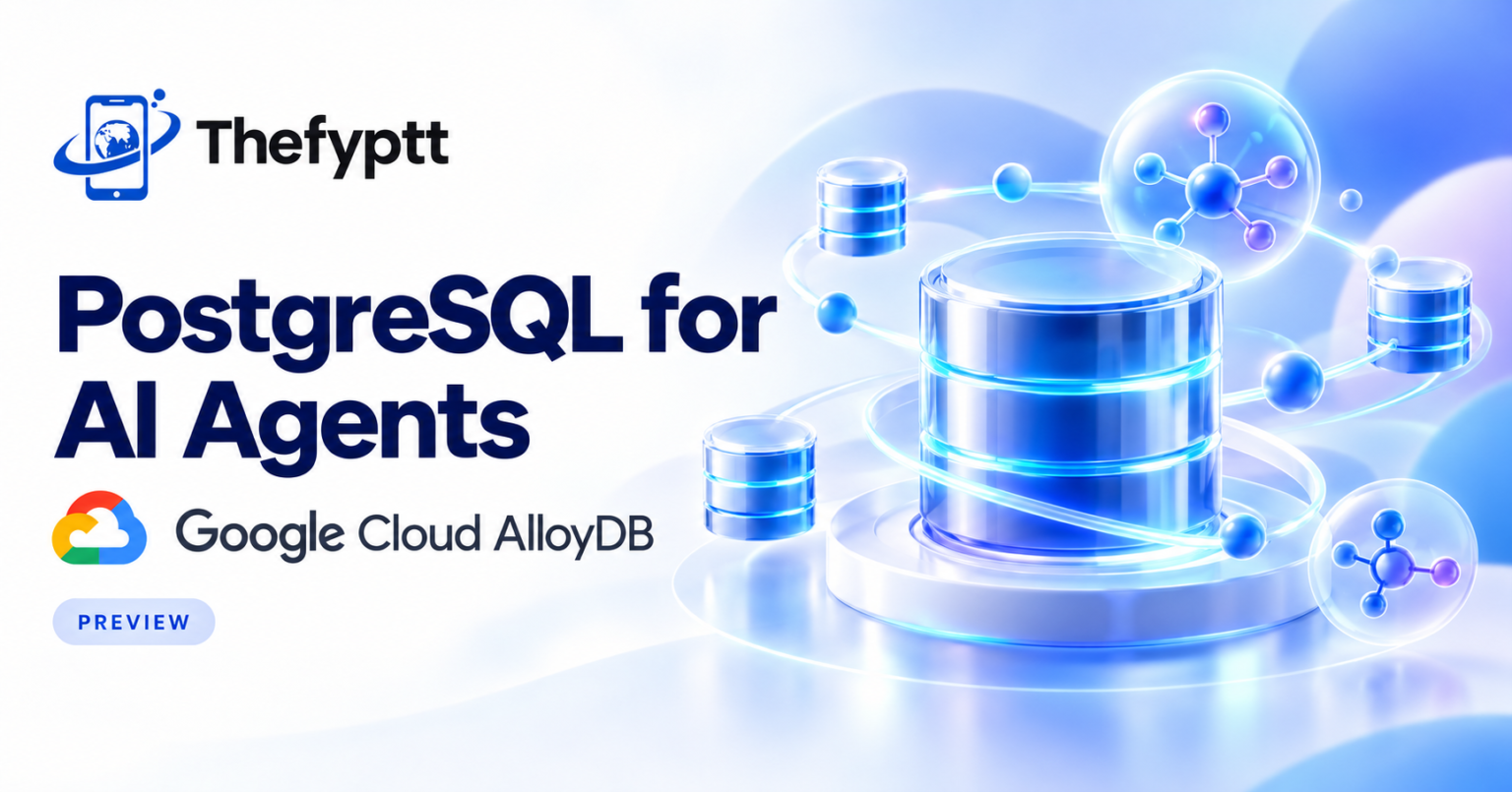

Google Cloud has announced AlloyDB PostgreSQL for agents, a preview feature designed to give AI agents access to current operational data while separating their query workloads from critical business systems.
In its September 24 announcement, Google says AlloyDB can provision sandboxed database instances within seconds and shut them down when agents finish. These instances provide read-only access to production data with up-to-the-second freshness.
The update addresses a practical challenge for businesses adopting AI: an agent may generate many database requests while working through one task. That activity needs capacity without disrupting the applications customers and employees already rely on.
What Is AlloyDB PostgreSQL for Agents?
The preview adds an architecture for running agent queries through separate database instances. Google says it can scale to thousands of serverless instances as demand increases.
The distinction between an AI agent and a database reader matters. An agent is the software carrying out a task; a reader is database infrastructure serving requests for information. Scaling readers therefore does not mean a fixed number of end users or website visitors.
The feature is currently described as a preview. It should not be presented as a generally available release or an automatic upgrade to every PostgreSQL installation.
How Google Separates Agent Queries From Production
Google’s technical architecture explanation describes an independent pool of AlloyDB nodes running inside lightweight microVMs. The agent pool uses dedicated storage segments to separate its read activity from the production data path.
According to Google, agents connect through the Model Context Protocol, or MCP. The nodes retain PostgreSQL database capabilities, including indexes and multiple search methods, while the agent pool can expand and return to zero as work starts and finishes.
This design focuses on workload isolation: separating the resources used to answer agent queries from those supporting the main application. That is a performance boundary, and should not be confused with deciding which information an agent is authorized to access.
What Does the “1,000+ Readers” Claim Mean?
The Google Cloud social post highlights scaling to more than 1,000 readers on demand. Its technical article reports a test across 1,000 agent nodes, reaching roughly 3 million queries per second with no measurable impact on primary-cluster performance in that benchmark.
Those figures are Google’s reported test results, not an independent evaluation by TheFYptt. They should not be treated as guaranteed performance for every application. Query complexity, data layout and workload mix remain important when comparing results.
Why Fresh Business Data Matters for AI Agents
Consider a hypothetical customer-service assistant checking whether an order can still be changed. It needs current order information; yesterday’s export could lead to an incorrect answer.
An inventory assistant faces a similar problem when checking stock before making a recommendation. In both examples, information freshness affects whether the response is useful.
These are potential applications of the announced approach, not customer deployments verified for this article. Access to recent data also does not prove that an agent will interpret it correctly or choose the right action.
What Businesses Should Evaluate
For teams considering this preview, the useful questions are concrete: How many reads does a typical task generate? How quickly do bursts arrive? Which records does the agent actually need? What happens when its task fails or repeats?
A representative trial should measure both agent response times and the behavior of the main application. It should also track the cost of completed tasks, rather than judging value only by how quickly extra readers appear.
AlloyDB PostgreSQL for agents points toward a clearer separation between running a business application and serving AI queries about its data. The preview gives teams an opportunity to evaluate that approach against their own workloads; Google’s published benchmarks provide context rather than a substitute for that evaluation.