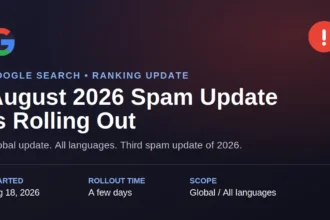




Google has started rolling out the September 2026 spam update, applying it worldwide across all languages. The company says the rollout may take up to two weeks to complete.
According to the Google Search Status Dashboard, the update began on September 24 at 9:15 a.m. PDT. That corresponds to 4:15 p.m. UTC and 9:15 p.m. Pakistan Standard Time on the same day.
As of September 25, Google had not posted a completion notice. Website owners should treat the rollout as ongoing rather than assume early ranking changes represent its final outcome.
September 2026 Spam Update: Confirmed Details
| Detail | Confirmed information |
| Update name | September 2026 spam update |
| Start date | September 24, 2026 |
| Start time | 9:15 a.m. PDT |
| Coverage | Global, across all languages |
| Estimated rollout | Up to two weeks |
| Status checked September 25 | No completion notice posted |
| Specific spam tactic targeted | Not specified in the release notice |
The two-week window is an estimate, not a confirmed completion date. Google’s dashboard remains the reference point for the end of the rollout.
What Is a Google Spam Update?
Google says its automated spam-detection systems operate continuously. A spam update marks a notable improvement to those systems, rather than the start of spam detection itself.
Its spam update guidance identifies SpamBrain as one of its AI-based spam-prevention systems. However, that general explanation does not establish which internal systems or tactics are the focus of this particular release.
Google labels this announcement a spam update. It has not identified it as a core update or a link-spam-only update.
What Has Google Said About the Targets?
The launch notice confirms timing and reach but does not name a particular industry, publishing method or link-building tactic.
That leaves an important boundary for reporting: claims that this release specifically targets AI-written articles, affiliate websites or guest posts are not established by the announcement.
Google’s existing Search spam policies still provide the relevant framework. They cover practices such as cloaking, keyword stuffing, link manipulation and scaled content abuse. Reviewing these policies is useful, but their existence is not evidence that any one category is the special focus of September’s update.
Does This Mean AI Content Is Automatically Spam?
The announcement does not introduce a blanket ban on AI-assisted content.
Google’s scaled content abuse policy focuses on producing many pages mainly to manipulate rankings rather than help readers. The policy applies regardless of how those pages are created, and includes AI-generated pages that add little value as an example.
For a publisher, the useful review is therefore specific: does a page answer its stated question, support its claims and offer something useful? A change of writing tool alone does not answer those questions.
What About Paid Links and Guest Posts?
Google’s link-spam policy covers buying or selling links for ranking purposes. A paid placement should not be assumed compliant simply because its topic matches the host website.
Google’s separate outbound-link guidance recommends rel=”sponsored” for advertisements and paid placements; rel=”nofollow” remains acceptable. These are link attributes in the page’s HTML.
For example, a paid link can be marked as:
<a href=”https://example.com/” rel=”sponsored”>Relevant anchor text</a>
This is existing guidance, not a newly announced requirement unique to the September rollout. The release also does not say that every guest contribution violates policy.
What Site Owners Should Check During the Rollout
Google’s traffic-drop troubleshooting guidance explains that search traffic can decline for several reasons, including technical issues, algorithmic changes and changes in demand. Timing alone does not diagnose the cause.
For a useful first review:
- Compare clicks and impressions. Identify whether the change affects a few URLs, a topic group or much of the site.
- Segment the results. Compare queries, pages, countries and devices to locate the strongest changes.
- Check other explanations. Review indexing problems, server issues and recent site changes before attributing everything to the update.
- Review Search Console notices. Check the Manual Actions and Security Issues reports. A ranking decline alone is not proof of a manual action.
- Record your changes. Keep a dated log of fixes so later performance comparisons remain meaningful.
TheFYptt’s practical recommendation is to avoid deleting useful pages solely because one day’s traffic is lower. Investigate the pattern and fix identifiable problems rather than making broad changes without evidence.
How Long Can Recovery Take?
Google says sites that violate its spam policies can lose rankings or disappear from results. Improvements may become possible when its automated systems recognize sustained compliance over a period of months.
That is not a promise that every site will recover within a fixed time. The rollout duration and a site’s recovery timeline are separate matters.
Google also notes that, in a link spam update, benefits previously supplied by spammy links cannot be regained once those benefits are neutralized. That general caveat should not be read as confirmation that September’s release is specifically a link spam update.
For now, the Google September 2026 spam update remains an ongoing rollout. Publishers can monitor the official dashboard, review their own search data and address concrete policy or technical issues while waiting for Google’s completion notice.