
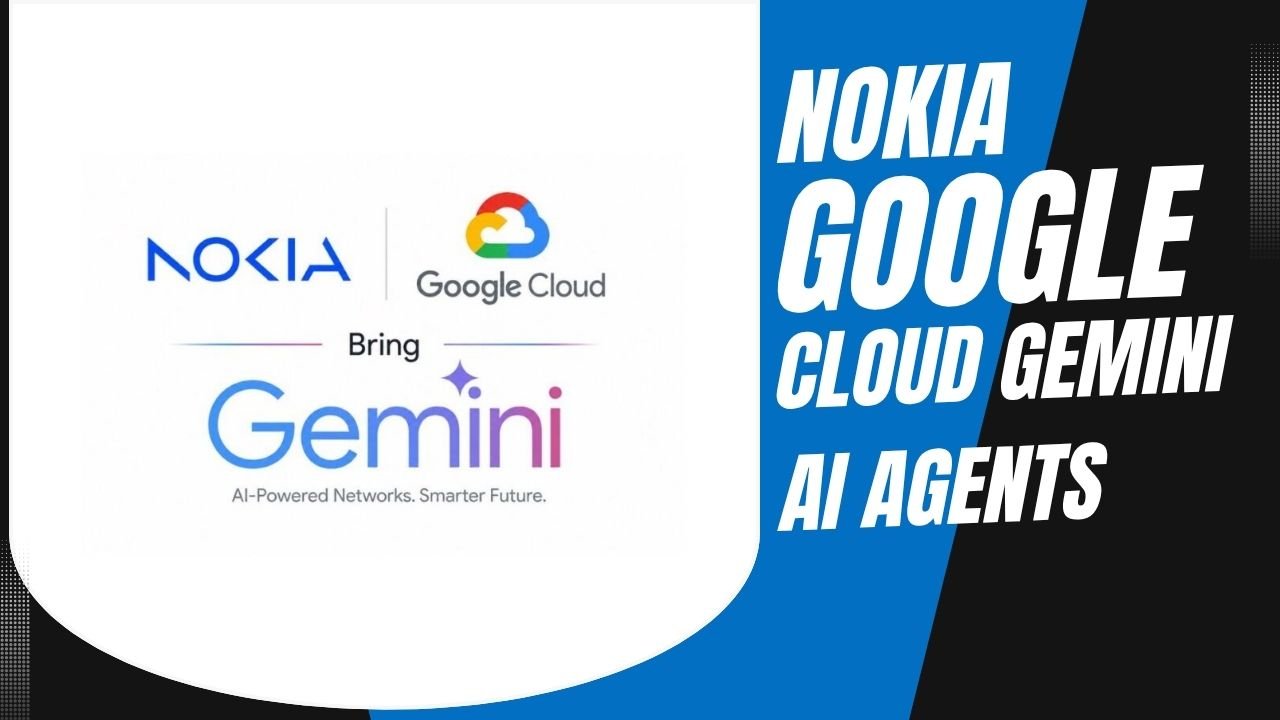

Nokia and Google Cloud just made a move that could fundamentally change how telecom networks are managed.
On June 22, 2026, the two companies announced an expanded partnership to embed six specialized AI agents built with Google’s Gemini models directly into Nokia’s Autonomous Network product suite, specifically the Nokia Assurance Center. The goal: cut the time it takes to find and fix network problems by 50% to 80%, and eventually move telecom operators toward fully self-driving network operations.
Two of the six agents are already live and fully functional right now. The full platform launches on the Google Cloud Marketplace in September 2026.
THE PROBLEM THEY’RE SOLVING
Modern telecom networks generate enormous volumes of data around the clock alarms, performance metrics, traffic patterns, service logs. The traditional way of managing this is manual troubleshooting: a network engineer receives an alert, investigates the cause, digs through historical data, identifies the issue, and then applies a fix. That process can take hours. During that time, the network may be degraded, calls may drop, and services may fail.
The core problem isn’t that engineers are slow. It’s that the volume of alerts has outpaced what humans can realistically process. Most operators are drowning in notifications, many of which turn out to be false alarms — which makes the real issues even harder to find.
Nokia and Google Cloud are building AI agents to solve exactly this.
THE SIX GEMINI-POWERED AGENTS
Nokia is introducing six specialized agents, each handling a specific part of the network operations workflow. They can work independently or coordinate together to solve complex, multi-layered problems:
- Router Agent Acts as the central brain. It interprets what the human operator wants, orchestrates communication between all other agents, and enforces operational guardrails throughout.
- Event Triage Agent Analyzes ongoing alarms in real time and compares them against historical patterns to identify root causes and understand operational impact. Already live.
- KPI Selector Agent Acts as a network performance expert, interpreting complex Key Performance Indicators to support reasoning by other agents.
- Anomaly Reasoner Agent Sorts genuine infrastructure problems from background noise and false alarms, so engineers only get alerted when something actually matters.
- Action Reasoner Agent Recommends specific remediation steps based on what the anomaly reasoner identified. Presents confidence-based recommendations to human engineers for approval before any fix is applied.
- Dashboard Agent Generates dynamic visual dashboards from natural language prompts. Instead of running queries or configuring tools, an operator just asks: “Show me voice quality degradation trends over the last 48 hours” and gets an instant visualization.
GLASS BOX AUTONOMY NOT BLACK BOX
One of the most important design decisions in this partnership is what Nokia calls “glass box autonomy.”
This is a deliberate contrast to “black box” AI, where the system makes decisions and no one fully understands why. With glass box autonomy, the agents handle the analytical heavy lifting pattern recognition, anomaly detection, root cause analysis, dashboard generation but human engineers retain final approval authority over any action that touches the actual network.
The Action Reasoner agent doesn’t fix things automatically. It presents recommendations with confidence levels, and the engineer approves or rejects before anything executes. This is designed specifically to earn operator trust in an industry where a wrong automated fix can cascade into wider outages.
WHAT’S ALREADY LIVE
Two of the six agents are fully functional today: the Router Agent and the Event Triage Agent. These form the backbone of the system everything else plugs into them.
The full SaaS platform, including a starter pack of certified agents, will be available for operators to deploy via the Google Cloud Marketplace in September 2026. The remaining four, more complex agents will be delivered through rolling software updates beginning in late 2026 and continuing through 2027.
Nokia’s VP of Secure and Autonomous Networks, Rodrigo Brito, confirmed there are “plenty of other” agents in the pipeline beyond the initial six — including a topology expert, a services design agent, and security-focused agents.
HOW IT’S BUILT
Nokia developed these agents using Google Cloud’s Agent Development Kit (ADK) on the Gemini Enterprise Agent Platform. Crucially, the entire framework runs on standard Google Cloud infrastructure — Kubernetes and Google Cloud Storage — without requiring custom managed services. That keeps costs down and makes it compatible with existing customer environments, including Google Cloud tenants.
This matters for operators weighing total cost of ownership. AI inference is not free, but by avoiding bespoke infrastructure, Nokia keeps the commercial model competitive.
THE COMPETITIVE ANGLE
This partnership doesn’t exist in a vacuum. Ericsson and Cisco both have AI-based network operations tooling of their own. And Huawei has AI-empowered network management deployed at scale across markets where it operates.
Nokia’s competitive argument is the specificity and coordination of the multi-agent setup versus a single monolithic assistant. Whether a coordinated ecosystem of specialized agents genuinely outperforms a tightly integrated proprietary stack is a question that production deployments will answer over the next 12 to 18 months.
One factor that works in Nokia and Google Cloud’s favor: transparency. A published rollout schedule, a SaaS distribution model, and an architecture built on standard cloud infrastructure is easier for Western operators to evaluate, procure, and audit than tools with a different geopolitical footprint.
WHERE YOU CAN SEE IT LIVE
Live demonstrations of these agents are on display at DTW Ignite in Copenhagen from June 23 to 25, 2026. Attendees can see a live voice degradation use case at the Google Cloud booth (#201) and the Nokia booth (#306), plus a multi-partner fiber-break automation simulation in the Innovation Zone.
BOTTOM LINE
This is what the agentic era looks like in enterprise infrastructure. Instead of one general-purpose AI assistant, Nokia and Google Cloud have built six specialized agents that each own a specific slice of the network operations workflow and hand off to each other seamlessly. The 50% to 80% reduction in troubleshooting time isn’t a marketing claim based on demos it’s backed by real deployments and a design specifically built for how telecom operators actually work. September 2026 is when operators can start deploying it themselves.